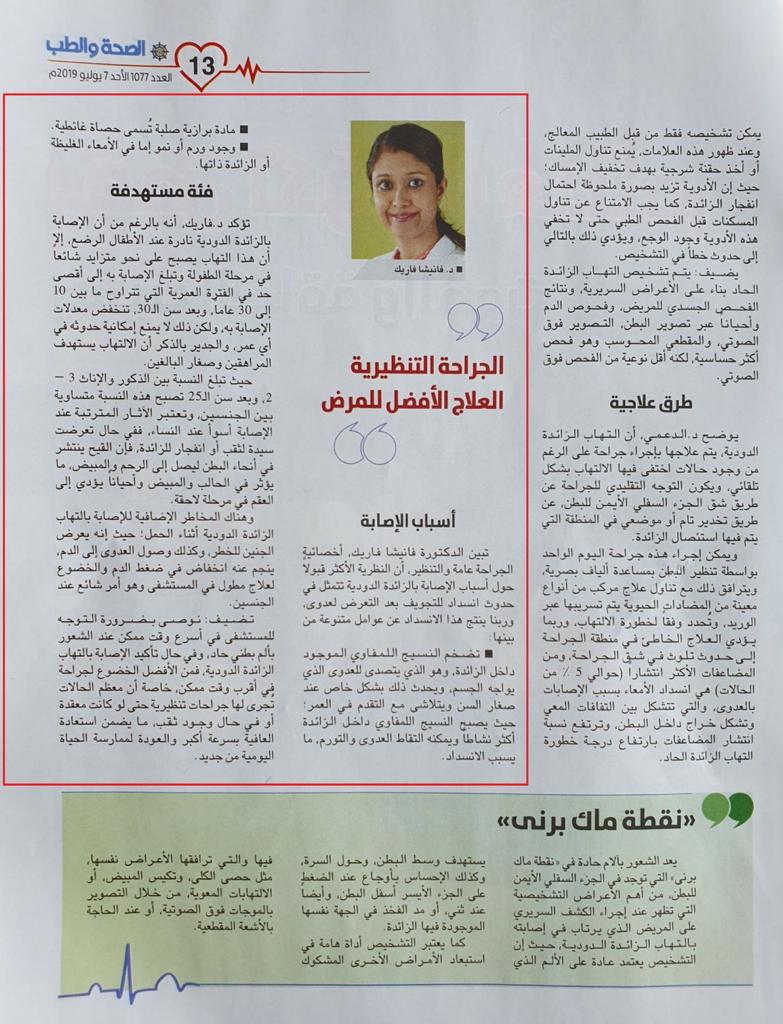
Appendicitis is one of the most common surgical emergencies worldwide, affecting people of all ages. When the appendix becomes inflamed, prompt diagnosis and treatment are essential to prevent life-threatening complications. Dr. Vanesha Varik, a female laparoscopic and general surgeon in Dubai, provides a comprehensive overview of appendicitis — from its root causes and symptoms to the recommended, most effective treatment: laparoscopic appendectomy.
What Is Appendicitis? Understanding the Condition
Appendicitis is the acute inflammation of the vermiform appendix — a small, finger-shaped pouch attached to the cecum (the beginning of the large intestine) in the lower right abdomen. While the exact function of the appendix remains debated, it is widely considered a vestigial organ and is not essential for normal digestive function.
When the appendix becomes blocked and inflamed, it fills with mucus, swells, and can become infected. Without timely treatment by a qualified appendix surgeon, the inflamed appendix can rupture (perforate), spreading infection throughout the abdominal cavity — a potentially life-threatening emergency known as peritonitis.
Causes of Appendicitis: Why Does the Appendix Get Inflamed?
Dr. Vanesha Varik explains that appendicitis occurs due to obstruction of the appendix lumen. This obstruction may be caused by:
- Lymphoid hyperplasia: Enlargement of lymphoid tissue inside the appendix, which commonly occurs in younger patients and is the most frequent cause in children and adolescents.
- Fecalith (hardened stool): The presence of a hardened stool particle inside the appendix, which is the most common cause of appendicitis in adults.
- Other causes: Foreign bodies, parasites, tumours, or inflammatory bowel disease can also occasionally cause appendiceal obstruction and subsequent appendicitis.
Once blocked, bacteria trapped inside the appendix multiply rapidly, causing the organ to swell, fill with pus, and become increasingly painful. This progression makes appendicitis a true surgical emergency requiring prompt evaluation by a laparoscopic surgeon in Dubai.
Symptoms of Appendicitis: Recognising the Warning Signs
Early recognition of appendicitis symptoms is critical for timely treatment and preventing complications. Common symptoms include:
- Sudden onset of pain around the navel that migrates to the lower right abdomen within hours
- Sharp, worsening pain that intensifies with movement, coughing, or deep breathing
- Nausea, vomiting, and loss of appetite
- Low-grade fever that may increase as the condition progresses
- Abdominal bloating and inability to pass gas
- Tenderness and guarding in the lower right abdomen (McBurney's point)
If you or a family member experience these symptoms, it is essential to visit a hospital or consult a general surgeon in Dubai immediately. Delaying treatment increases the risk of appendix rupture and serious complications.
Who Is at Risk? Appendicitis by Age and Gender
Dr. Vanesha Varik confirms that appendicitis can affect all age groups; however, the incidence is highest among children and young adults between the ages of 10 and 30 years. After the age of 30, the likelihood of appendicitis decreases but it can still occur at any age — meaning every person remains at risk throughout their lifetime.
Statistics indicate that males are slightly more affected than females during adolescence. After the age of 25, the incidence becomes approximately equal between both genders. Appendicitis in elderly patients can be more challenging to diagnose due to atypical symptom presentation and may carry higher complication rates, making experienced surgical evaluation essential.
Important for women: In cases where a woman experiences a ruptured appendix, pus may spread into the abdominal cavity, reaching the pelvis and ovaries, which may negatively affect fertility. This is why early diagnosis and prompt laparoscopic surgery are especially important for women of reproductive age.
Diagnosis of Appendicitis: How Is It Confirmed?
Appendicitis can only be diagnosed by a treating physician or surgeon through a combination of clinical assessment and diagnostic investigations:
Clinical Examination
The surgeon performs a thorough physical examination, assessing for tenderness at McBurney's point (the classic location of appendicitis pain in the lower right abdomen), rebound tenderness, and signs of peritoneal irritation. The clinical history — including the pattern of pain migration and associated symptoms — is crucial for diagnosis.
Blood Tests
Blood tests are performed to check for elevated white blood cell count (leukocytosis), which indicates infection and inflammation. C-reactive protein (CRP) levels may also be measured to assess the severity of inflammation.
Imaging Studies
Abdominal ultrasound is commonly used as a first-line imaging investigation because it is safe, non-invasive, and does not involve radiation. CT scan may be required for more complex or unclear cases and provides highly accurate diagnosis. In pregnant women, ultrasound or MRI is preferred to avoid radiation exposure.
Treatment: Why Laparoscopic Appendectomy Is the Gold Standard
Appendicitis is treated surgically, and laparoscopic appendectomy is the preferred treatment worldwide. This minimally invasive procedure involves making three small incisions (5–12mm each) through which a high-definition camera and surgical instruments are inserted to locate and remove the inflamed appendix safely.
Advantages of Laparoscopic Appendectomy Over Open Surgery
- Significantly less post-operative pain due to smaller incisions
- Faster recovery — most patients return to normal activities within one to two weeks
- Shorter hospital stay — same-day discharge or one overnight stay in most cases
- Smaller, barely visible scars compared to the larger open surgery incision
- Lower risk of wound infection and post-operative adhesions
- Better diagnostic capability — the camera allows the surgeon to inspect the entire abdomen
In some mild, uncomplicated cases, antibiotics may be used as a temporary measure. However, surgery remains the definitive treatment because conservative management carries a significant recurrence rate. Dr. Vanesha Varik, an experienced laparoscopic surgeon in Dubai, recommends appendectomy as the recommended treatment for appendicitis.
Recovery After Laparoscopic Appendix Surgery
Recovery after laparoscopic appendectomy is typically quick and straightforward:
- Day of surgery: Walking within hours, light oral intake, mild discomfort managed with pain medication
- Days 1–3: Most patients are discharged and can manage at home with oral pain relief and rest
- Days 4–7: Gradual return to light daily activities; most patients can shower and move around comfortably
- Weeks 1–2: Return to desk work and normal routine; avoid heavy lifting
- Weeks 3–4: Full recovery with return to exercise and strenuous activities
Patients are usually given antibiotics post-operatively, and the duration of antibiotic treatment depends on the severity of inflammation. Dr. Vanesha Varik provides personalised post-operative instructions and follow-up care to ensure a smooth recovery.
Complications of Untreated Appendicitis: Why You Should Not Delay
Delayed treatment of appendicitis can lead to serious, potentially life-threatening complications:
- Appendix rupture (perforation) — the most dangerous complication, typically occurring 48–72 hours after symptom onset
- Peritonitis — widespread infection of the abdominal lining requiring emergency surgery and prolonged antibiotic treatment
- Abscess formation — a walled-off collection of pus that may require drainage
- Sepsis — life-threatening bloodstream infection that can affect multiple organs
- Longer hospital stays, higher complication rates, and slower recovery if emergency surgery is needed for ruptured appendicitis
This is why early clinical evaluation and timely surgery are critical. A planned laparoscopic appendectomy for acute appendicitis carries significantly lower risks than emergency surgery for a ruptured appendix.
"Your Pain Doesn't Lie"
After initial pain begins, appendicitis pain typically localizes to the lower right side of the abdomen. Symptoms often worsen with movement or pressure.
Early diagnosis relies heavily on recognizing pain patterns, as imaging and blood tests support — but do not replace — clinical evaluation by an experienced appendix surgeon.
Why Choose Dr. Vanesha Varik for Appendix Surgery in Dubai?
Dr. Vanesha Varik is a female laparoscopic and general surgeon at Medcare Hospital Dubai with extensive experience in emergency and elective appendix surgery. Her patient-centred approach, combined with advanced laparoscopic skills, ensures:
- Safe, precise laparoscopic appendectomy with minimal scarring
- Same-day or next-day discharge for uncomplicated cases
- Comprehensive pre-operative evaluation and personalised treatment planning
- Detailed post-operative care instructions and follow-up
- A compassionate, culturally sensitive approach to patient care
Whether you need urgent evaluation for suspected appendicitis or a second opinion on a previous diagnosis, Dr. Vanesha Varik provides expert, evidence-based surgical care. Learn more about her laparoscopic surgery expertise or explore other surgical services including gallbladder surgery, hernia repair, and breast surgery.
Frequently Asked Questions About Appendicitis & Appendix Surgery
Dr. Vanesha Varik
Consultant, General & Laparoscopic Surgery · Medcare Hospital Dubai